 YAVE
Bayer 04 Leverkusen
From "Neverkusen" to invincible: the factory team that waited 120 years for a league title, then won it unbeaten
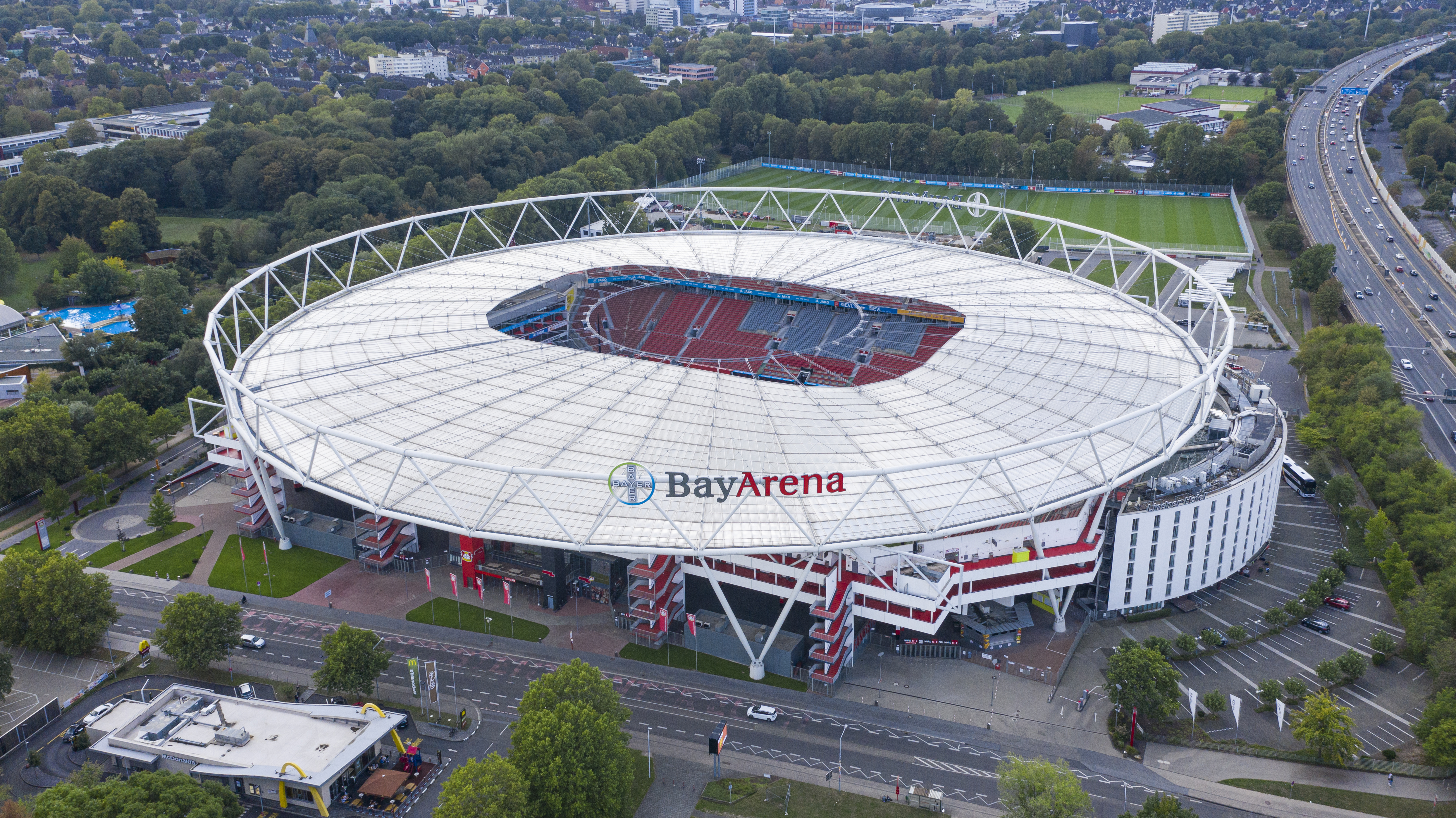
Bayer 04 Leverkusen are Die Werkself, the Factory XI — Die Schwarzroten, the Black and Reds of Leverkusen, the North Rhine-Westphalian city that grew around the Bayer works and took its name from them. The club began on 1 July 1904, when the Turn- und Spielverein Bayer 04 was founded as a works team after Bayer employee Wilhelm Hauschild wrote to the company's management in November 1903 with a letter signed by around 170–180 of his fellow workers. The football department followed on 31 May 1907. Their home since 1958 is the BayArena, holding 30,210 for league matches and 29,412 for international matches.
For most of their history Leverkusen were Germany's nearly-men. Before 2024 their entire major trophy cabinet held two items — the 1988 UEFA Cup and the 1993 DFB-Pokal — in 120 years, against five Bundesliga runners-up finishes and the 2002 season in which three trophies were lost in eleven days. Then Xabi Alonso's side won the club's first league title in 2023–24 without losing a match, and completed a domestic double: the 2023–24 season doubled the club's all-time major trophy tally in a single year.
Contents
- A factory team (1904–1945)
- Post-war climb (1945–1979)
- Establishment and first trophies (1979–1993)
- The nearly-men: Daum, Unterhaching and the treble horror (1993–2002)
- The consistent contenders (2002–2022)
- Alonso and the end of "Neverkusen" (2022–2026)
- Honours
- Timeline
- References
1. A factory team (1904–1945)
Membership of the new gymnastics and games club was at first restricted to Bayer employees and their families. German sport of the era was split between gymnasts and ball players, and after the gymnastics association's "clean divorce" decree the footballers separated from the gymnasts in the 1920s — first as FV 04 Leverkusen in 1923 and as Sportvereinigung Bayer 04 Leverkusen by 1928 — keeping the red-and-black colours. In 1930 Wiesdorf and its neighbours merged into the new town of Leverkusen, named for the factory, and the club now bore its city's name. In 1936 Leverkusen were promoted to the second-highest class of the period and first wore the Bayer cross on their kits, the company emblem they carry still. Through the 1930s the Werkself played third- and fourth-division football: a genuine works team, decades before that became a controversy.
2. Post-war climb (1945–1979)

Leverkusen's first taste of the top flight came in the Oberliga West from 1951 to 1956, played at the Stadion Am Stadtpark. On 2 August 1958 the club moved to the new Ulrich-Haberland-Stadion, named after a former Bayer chairman and opened with a capacity of 20,000. Back in the upper league in 1962, a year before the Bundesliga's creation, Leverkusen then settled in the second-tier Regionalliga West: champions there in 1968 with a 15-man squad, but beaten in the promotion round. Relegation to the third tier in 1973 was undone at once, into the new 2. Bundesliga, and in 1978–79 Leverkusen won the 2. Bundesliga Nord — promoted to the Bundesliga for the first time in 1979, beginning an unbroken top-flight membership that has now run for 47 consecutive seasons.
3. Establishment and first trophies (1979–1993)

By the mid-1980s Leverkusen were consolidated in the Bundesliga's upper half. In 1984 the two halves of the old club reunited as TSV Bayer 04 Leverkusen. First European qualification came in April 1986, and the European debut followed in the 1986–87 UEFA Cup. Then, in 1988, the first great night: in the UEFA Cup final, Erich Ribbeck's side lost the first leg 3–0 to Espanyol in Barcelona — and won the second leg 3–0 at home, Tita, Falko Götz and Cha Bum-kun scoring, before winning the shoot-out 3–2, goalkeeper Rüdiger Vollborn the hero. It was the club's first major trophy. Reiner Calmund became general manager in 1988; after reunification he signed East German stars Ulf Kirsten and Andreas Thom at once, in 1990. On 12 June 1993 Leverkusen won their first domestic honour, the DFB-Pokal, beating Hertha BSC's reserve side, Hertha BSC Amateure — still the only reserve team ever to reach the final — 1–0 in Berlin, Kirsten heading the winner in the 77th minute. Leverkusen are one of two grandfathered exceptions, with VfL Wolfsburg, to the DFL's 50+1 rule: because Bayer had funded the works club's football department continuously and substantially for more than 20 years before the rule's cut-off, Bayer AG was permitted to retain 100% ownership when the professional team was spun off into a GmbH in 1999 — an exemption popularly dubbed the "Lex Leverkusen". The member-owned parent club, TSV Bayer 04 Leverkusen e.V., still exists.
4. The nearly-men: Daum, Unterhaching and the treble horror (1993–2002)

After nearly being relegated in 1996, Christoph Daum's side became serial contenders: runners-up in 1996–97, 1998–99 and, cruellest of all, 1999–2000, when the title was lost on the final day — needing only a draw at SpVgg Unterhaching, Leverkusen lost 0–2, Michael Ballack scoring an own goal, while Bayern won to take the title on goal difference. Daum was sacked in 2000 over a cocaine scandal. Under Klaus Toppmöller in 2001–02 it happened on a grander scale: a five-point league lead surrendered in the last three games, the title gone on 4 May; the DFB-Pokal final lost 4–2 to Schalke on 11 May, Dimitar Berbatov and Kirsten scoring Leverkusen's goals; and the Champions League final lost 2–1 to Real Madrid at Hampden Park on 15 May, Lúcio's header cancelled out in memory by Zinedine Zidane's volley. Three trophies in eleven days: the "Treble Horror" fixed the labels — "Vizekusen" in German, "Neverkusen" in the English-language media. Kirsten, a three-time Bundesliga top scorer, retired as the club's record scorer: 182 goals in the Bundesliga and 240 in all competitions. Vollborn, the one-club goalkeeper, remains the record appearance holder with 401 Bundesliga appearances and more than 480 competitive appearances in total.
5. The consistent contenders (2002–2022)
Two decades of top-four finishes and Champions League football followed without a trophy. There was a 3–0 group-stage win over Real Madrid in 2004–05; the 2009 DFB-Pokal final lost 0–1 to Werder Bremen; second place in 2010–11 under Jupp Heynckes, who then left for Bayern; third places under Sami Hyypiä in 2012–13 and Roger Schmidt in 2015–16, Stefan Kießling finishing as the Bundesliga's top scorer in 2012–13; and the 2020 DFB-Pokal final lost 2–4 to Bayern Munich in an empty Olympiastadion during the COVID-19 pandemic. The academy became the club's calling card — Kai Havertz first, then Florian Wirtz. Leverkusen were always there, and never quite there: the first club to reach a Champions League final, in 2002, without ever having won a national championship.
6. Alonso and the end of "Neverkusen" (2022–2026)

Xabi Alonso was appointed in October 2022 with Leverkusen in the relegation zone, in his first senior head-coach job; he took them to sixth. What followed in 2023–24 was historic: the Bundesliga won for the first time in the club's history, clinched on 14 April 2024 with a 5–0 win over Werder Bremen, and completed unbeaten — 28 wins, 6 draws, 90 points, the first unbeaten season in Bundesliga history. Leverkusen went 51 consecutive competitive matches without defeat, all in that one season — a record for a club from Europe's top-five leagues in the UEFA era, breaking Benfica's 48-match mark from 1963–65; the run ended with the Europa League final, a 3–0 defeat by Atalanta in Dublin, their 52nd match of the span and their only defeat in 53. Three days later they completed the double, beating Kaiserslautern 1–0 in the Pokal final, Granit Xhaka scoring, playing the second half with ten men. The 2024 Supercup followed, won on penalties against Stuttgart. In 2024–25 Leverkusen finished runners-up; Alonso announced on 9 May 2025 that he would leave for Real Madrid, and that summer Wirtz and Jeremie Frimpong joined Liverpool — Wirtz for a reported fee of £100 million guaranteed, rising to a potential British-record £116 million with add-ons — and Jonathan Tah joined Bayern. The 2025–26 season was turbulent: Erik ten Hag, appointed that summer, was sacked on 1 September 2025 after just two Bundesliga matches, a German record; Kasper Hjulmand steadied the side, the club's 37-match unbeaten Bundesliga away run ended at Bayern in November, and Leverkusen closed the season sixth in the Bundesliga with 59 points, Pokal semi-finalists and Champions League round-of-16 participants.
Honours
| Competition | Success | Notes |
|---|---|---|
| Bundesliga | Champions 2023–24 | The club's first German championship, won unbeaten (W28 D6, 90 points); runners-up six times |
| DFB-Pokal | Winners 1992–93, 2023–24 | Beat Hertha BSC Amateure in 1993 and Kaiserslautern in 2024; runners-up in 2002, 2009 and 2020 |
| UEFA Cup | Winners 1987–88 | Beat Espanyol on penalties after a 3–3 aggregate draw |
| UEFA Champions League | Finalists 2001–02 | Lost 1–2 to Real Madrid at Hampden Park |
| UEFA Europa League | Finalists 2023–24 | Lost 0–3 to Atalanta in Dublin — the only defeat of the season |
| DFL-Supercup | Winners 2024 | Beat VfB Stuttgart on penalties; the club's first Supercup |
| 2. Bundesliga Nord | Champions 1978–79 | The promotion season |
Timeline
- 1903 — November: Wilhelm Hauschild writes to Friedrich Bayer & Co. seeking support for a sports club.
- 1904 — 1 July: Turn- und Spielverein Bayer 04 founded as a works team.
- 1907 — 31 May: the football department is formed.
- 1923 / 1928 — The footballers separate from the gymnasts (FV 04 in 1923; Sportvereinigung Bayer 04 Leverkusen by 1928), keeping red and black.
- 1930 — The town of Leverkusen is created from Wiesdorf and its neighbours.
- 1936 — Promotion to the second-highest class; the Bayer cross is first worn on the kit.
- 1958 — 2 August: the Ulrich-Haberland-Stadion opens.
- 1968 — Regionalliga West champions; the promotion round is unsuccessful.
- 1979 — 2. Bundesliga Nord champions: promoted to the Bundesliga for the first time. Unbroken top-flight membership begins.
- 1984 — 1 July: TSV Bayer 04 Leverkusen e.V. reunification.
- 1986 — 26 April: first European qualification secured (2–2 at Schalke).
- 1988 — 4 May: UEFA Cup final first leg — Espanyol 3–0 Leverkusen. 18 May: Leverkusen 3–0 Espanyol — 3–3 on aggregate; Leverkusen win 3–2 on penalties. First major trophy.
- 1988 — Reiner Calmund becomes general manager.
- 1990 — Post-reunification signings of Ulf Kirsten and Andreas Thom.
- 1993 — 12 June: DFB-Pokal final, Berlin — Leverkusen 1–0 Hertha BSC Amateure (Kirsten 77'). First domestic honour.
- 1999 — 1 April: Bayer 04 Leverkusen Fußball GmbH spun off; wholly owned by Bayer AG.
- 2000 — May: the title is lost on the final day at Unterhaching (0–2; Bayern champions on goal difference).
- 2002 — 4 May: the Bundesliga title is lost on the final day. 11 May: DFB-Pokal final lost 2–4 to Schalke. 15 May: Champions League final lost 1–2 to Real Madrid — the "Treble Horror".
- 2009 — 30 May: DFB-Pokal final lost 0–1 to Werder Bremen.
- 2020 — 4 July: DFB-Pokal final lost 2–4 to Bayern Munich in an empty Olympiastadion.
- 2022 — October: Xabi Alonso appointed head coach with the club in the relegation zone; 2022–23 ends in 6th place.
- 2024 — 14 April: Bundesliga champions for the first time — 5–0 v Werder Bremen, the title with five games to spare.
- 2024 — 18 May: the league season is completed unbeaten (W28 D6) — the first time in Bundesliga history.
- 2024 — 22 May: Europa League final, Dublin — Atalanta 3–0 Leverkusen, the only defeat of the season. 25 May: DFB-Pokal final — Kaiserslautern 0–1 Leverkusen: the club's first double.
- 2024 — 17 August: the DFL-Supercup is won — 2–2 v VfB Stuttgart, 4–3 on penalties.
- 2025 — 9 May: Alonso announces his departure for Real Madrid; the season ends with Leverkusen 2nd. June: Wirtz and Frimpong join Liverpool; Tah joins Bayern.
- 2025 — 1 September: Erik ten Hag is sacked after two Bundesliga matches — a German record. 8 September: Kasper Hjulmand appointed.
- 2026 — May: 2025–26 ends — Bundesliga 6th (59 points), DFB-Pokal semi-final, Champions League round of 16.
References
- Bayer 04 Leverkusen — club history, honours and records, cross-checked between the English and German reference records of the club and the club's own site bayer04.de (foundation 1 July 1904; the BayArena record — opened 2 August 1958 as the Ulrich-Haberland-Stadion, capacity 30,210 for league matches and 29,412 for international matches), bundesliga.com's club-by-club historical guide, UEFA.com's account of the 1988 UEFA Cup final and the DFB Datencenter's record of the 2024 DFB-Pokal final.
- The records, scope-locked: Bundesliga only — Rüdiger Vollborn 401 appearances, Ulf Kirsten 182 goals in 350 appearances; all competitions — Kirsten 240 goals in 448 appearances. Vollborn's all-competitions appearance total is reported inconsistently by the sources (487, 483 and 481 all appear), so no single exact total is printed; the Bundesliga figures are settled.
Image source: Wikimedia Commons.


