 YAVE
Holstein Kiel
The 61-Year Wait: Holstein Kiel's Road from the 1912 Title to the Bundesliga
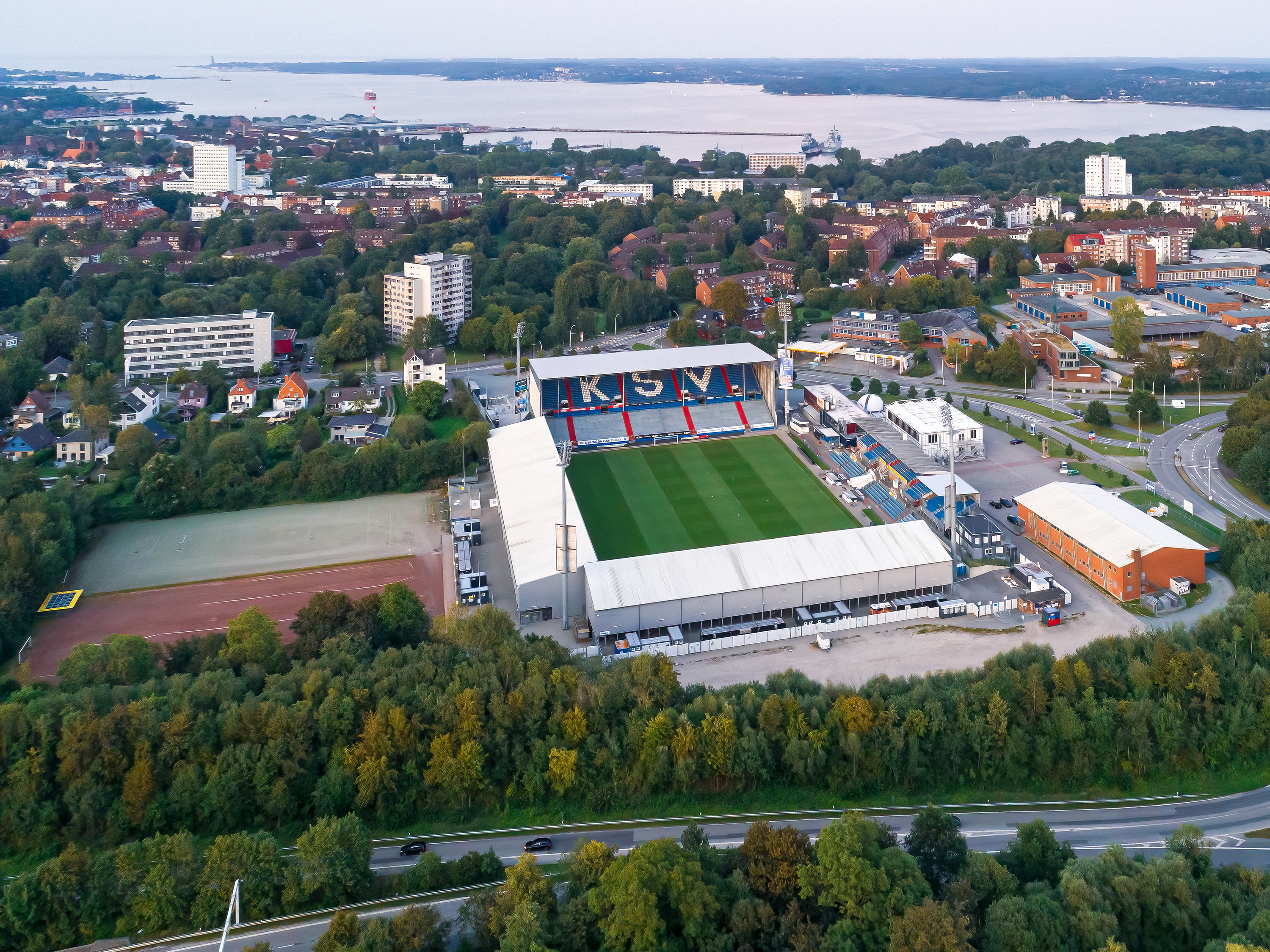
Holstein Kiel — the KSV Holstein — are the club who waited 61 years to reach the Bundesliga. Formed on 7 June 1917 by the merger of two Kiel clubs who had run in parallel since the beginning of the century, they carry a German championship won in 1912 by one of those predecessors, FV Holstein von 1902, and a ground, the Holstein-Stadion, that has stood on the same site since 1911. Locked out of the Bundesliga in 1963, Kiel wandered the amateur divisions for decades before climbing back, beating Bayern Munich in a famous cup night in 2021, and finally reaching the top flight in 2024 as the first club from Schleswig-Holstein to do so. The stadium holds 15,034, and in the last completed season, 2025–26, Kiel finished 12th in the 2. Bundesliga with 41 points.
Contents
- Two Clubs, One City, a Championship (1900–1917)
- Northern Power and Wartime Peaks (1917–1945)
- Oberliga Ever-Presents, Locked Out in 1963 (1945–1963)
- The Long Amateur Decades (1963–1994)
- Fourth-Tier Falls and the Slow Climb (1994–2017)
- Play-Off Heartbreak, the Bayern Night and the Summit (2017–2026)
- Honours
- Timeline
- References
Two Clubs, One City, a Championship (1900–1917)

There was no single founding merger in 1900. Kieler FV von 1900 was founded on 7 October 1900 out of the football section of the Kieler Männerturnverein, while Kieler FC Holstein was founded separately on 4 May 1902, becoming FV Holstein von 1902 in 1908 and SV Holstein von 1902 in 1914. It was the Holstein line that made history. In 1910 FV Holstein reached the German championship final, losing 0–1 after extra time to Karlsruher FV in Cologne — an older Karlsruhe club, not part of today's Karlsruher SC. On 26 May 1912, at the Stadion Hoheluft in Hamburg, they went one better, beating the same Karlsruher FV 1–0 with an Ernst Möller penalty to become German champions; the semi-final had been won 2–1 after extra time against Viktoria 89 Berlin. Holstein also won the German Academic championship of 1912, beating VfB Marburg 2–0 — a period curiosity remembered as the first DFB "double". The Holstein-Platz opened on 15 October 1911, and on 7 June 1917, in the middle of the war, the two Kiel clubs finally merged as KSV Holstein von 1900, the name the club still carries.
Northern Power and Wartime Peaks (1917–1945)
The Holstein line were Northern German champions six times — 1910, 1911, 1912, 1926, 1927 and 1930 — and runners-up seven times, and the merged club remained the north's leading challenger. In the 1930 final Kiel lost a thriller 4–5 to Hertha BSC in Düsseldorf. The club reached the finals rounds thirteen times in all, losing semi-finals in 1911, 1913, 1926, 1931 and 1943, and taking third place in 1943 by beating First Vienna 4–1 in Berlin. Founder members of the Gauliga Nordmark in 1933 and its runners-up in 1937, Kiel were champions of the wartime Gauliga Schleswig-Holstein in 1943 and 1944. Their great cup run came in the Tschammerpokal of 1941 — not 1943 — when they beat Hamburger SV, Werder Bremen, Blau-Weiß 90 and Jena to become the first Schleswig-Holstein club to reach a German cup semi-final, losing 0–6 at Schalke. In May 1943, in the championship quarter-final, Kiel beat Schalke 4–1 at the Holstein-Platz before 18,000.
Oberliga Ever-Presents, Locked Out in 1963 (1945–1963)
The post-war years began with a scandal: in 1948–49 Kiel were thrown out of the Oberliga Nord after eight matchdays over the ineligible-player affair involving Willy Hamann, their record annulled, before being readmitted for 1949–50. They were founder members of the Oberliga Nord and one of only five clubs to play all sixteen of its seasons, finishing runners-up in 1953 and 1957 — in 1957 they lost the qualifying tie for the championship rounds 2–3 after extra time to Kickers Offenbach. The ground's record crowd of 30,000 saw a 3–3 draw with Hamburger SV on 23 March 1951. The post-war records, stated for that era only, belong to Hans-Peter Ehlers, with 368 appearances between 1953 and 1966, and Gerd Koll, with 141 goals between 1959 and 1968; goalkeeper Henry Peper made 271 appearances. In 1963 Kiel finished fifth in the final Oberliga Nord season — but the Bundesliga places went to Hamburg, Werder Bremen and Eintracht Braunschweig, and Kiel's protests failed. The 61-year wait had begun.
The Long Amateur Decades (1963–1994)

Kiel won the second-tier Regionalliga Nord in 1965 but finished third in the promotion group behind Borussia Mönchengladbach. In 1974 they missed the new 2. Bundesliga on the five-year ranking and fell to the third tier for the first time. Promotion came in 1978 through a play-off against Paderborn — two 2–2 draws, then a third game won on penalties — but after three second-division seasons, finishing 14th, 14th and 19th, the single-division reform of 1981 relegated Kiel anyway. The club had sold the Holstein-Stadion to the City of Kiel in 1973, and money troubles followed: near-bankruptcy in 1989, when 400,000 DM of debt was written off, and further debts in 1994. One honour of the era needs careful fencing: the German amateur championship of 1961 was won by Kiel's reserve team, 5–1 against Siegburger SV, not by the first team. The first team's own cup, the SHFV-Pokal, would eventually be won thirteen times between 1978 and 2017.
Fourth-Tier Falls and the Slow Climb (1994–2017)

Kiel dropped to the fourth tier in 1996, won the Oberliga Hamburg/Schleswig-Holstein in 1998 and again in 2001 — the second promotion arriving through Göttingen's licence refusal — and were relegated in 2007 when four clubs finished on 48 points and Kiel had the worst goal difference. Champions of the Oberliga Nord in 2008 and of the Regionalliga Nord in 2009, the title sealed on the final day, they lasted one season in the 3. Liga. As a fourth-tier club in 2011–12 they reached the DFB-Pokal quarter-finals, beating Energie Cottbus, MSV Duisburg and Mainz 05 before losing 0–4 to Borussia Dortmund. The Regionalliga title of 2013 and a play-off win over Hessen Kassel restored third-tier football, and in 2015 Kiel led 1860 München 1–0 away in the promotion play-off before losing 1–2 in stoppage time — heartbreak that would become a habit before it became a spur.
Play-Off Heartbreak, the Bayern Night and the Summit (2017–2026)

In 2017, runners-up in the 3. Liga with 67 points, Kiel returned to the second division after 36 years under coach Markus Anfang, and in 2017–18 finished third with 71 goals — only to lose the promotion play-off to VfL Wolfsburg, 1–4 on aggregate. Tim Walter coached the side in 2018–19 and Ole Werner from 2019 until October 2021. On 13 January 2021 came the night the whole country watched: Kiel drew 2–2 with Bayern Munich after extra time and beat the European champions 6–5 on penalties, going on to the cup semi-finals, where they lost 0–5 at Borussia Dortmund on 1 May 2021; in the league they finished third again and lost another play-off, to 1. FC Köln. Marcel Rapp, appointed on 4 October 2021, finally finished the job: second place in 2023–24 with 68 points, promotion sealed by a 1–1 draw with Fortuna Düsseldorf on 11 May 2024 — the first Bundesliga club from Schleswig-Holstein. The top-flight season brought famous wins — a first victory, 1–0 against Heidenheim on 2 November 2024, a 5–1 against Augsburg on 21 December, a 4–2 defeat of Borussia Dortmund on 14 January 2025 after leading 3–0 at half-time, and a 4–3 against Borussia Mönchengladbach in April — but Kiel finished 17th with 25 points and went straight back down. Rapp left by mutual agreement on 24 February 2026 with the club 14th, and Tim Walter, returning for a second spell from 25 February 2026, completed the season: 12th place in the 2. Bundesliga with 41 points, and a DFB-Pokal quarter-final defeat by VfB Stuttgart. A new stadium of around 22,000 seats was announced as a project in December 2025, scheduled for 2026–2030 — an announcement, not yet a building. The club's membership stood at 12,000 as of 31 March 2026.
Honours
| Competition | Titles | Years / Notes |
|---|---|---|
| German Championship | 1 | 1912 (as FV Holstein von 1902; runners-up 1910, 1930) |
| Northern German Championship | 6 | 1910, 1911, 1912, 1926, 1927, 1930 |
| Gauliga Schleswig-Holstein | 2 | 1943, 1944 |
| Regionalliga Nord | 3 | 1965 (second tier); 2009, 2013 (fourth tier) |
| SHFV-Pokal | 13 | First-team wins, 1978–2017 |
| NFV-Pokal | 7 | — |
| German Academic Championship | 1 | 1912 (as FV Holstein von 1902) |
Timeline
1900 — Kieler FV von 1900 founded on 7 October.
1902 — Kieler FC Holstein founded on 4 May.
1910 — German championship final lost 0–1 after extra time to Karlsruher FV.
1911 — The Holstein-Platz opens on 15 October.
1912 — German champions: FV Holstein beat Karlsruher FV 1–0 in Hamburg.
1917 — The two Kiel clubs merge on 7 June as KSV Holstein von 1900.
1930 — Championship final lost 4–5 to Hertha BSC.
1941 — Tschammerpokal semi-finalists — the first Schleswig-Holstein club to get that far.
1943 — Third place in the German championship; Gauliga Schleswig-Holstein champions.
1948 — Expelled from the Oberliga Nord in the Hamann affair; readmitted a year later.
1951 — Record crowd of 30,000 against Hamburger SV.
1963 — Fifth in the Oberliga Nord, but no Bundesliga place — the long wait begins.
1965 — Regionalliga Nord champions; promotion group lost to Gladbach.
1978 — Promoted to the 2. Bundesliga through the Paderborn play-off.
2009 — Regionalliga Nord champions and into the 3. Liga.
2012 — DFB-Pokal quarter-finalists as a fourth-tier club.
2017 — Back in the 2. Bundesliga after 36 years.
2021 — Bayern Munich beaten on penalties in the DFB-Pokal; semi-finalists.
2024 — Promoted to the Bundesliga — a first for Schleswig-Holstein.
2025 — Relegated after one Bundesliga season.
2025–26 — 12th in the 2. Bundesliga with 41 points.
References
- Holstein Kiel — Wikipedia (German and English editions)
- German football championship finals 1910, 1912 and 1930
- Holstein-Stadion — Wikipedia (German edition)
- kicker.de — club archive, Holstein Kiel
- DFB Datencenter — club and cup records
- Holstein Kiel official website — holstein-kiel.de
Image source: Wikimedia Commons.


