 YAVE
KFC Uerdingen 05
Bayer's works club, Bayern's conquerors: one cup, the greatest match of all time, and survival in the fifth tier

KFC Uerdingen 05 — in full, the Krefelder Fußballclub Uerdingen 05 e.V. — come from Uerdingen, the old Rhine port district of Krefeld in North Rhine-Westphalia, and play in blue and red, the colours of the town of Uerdingen. Their mascot is the Grotifant, an elephant named for the Grotenburg and the German word for elephant. The club was founded on 17 November 1905 as FC Uerdingen 05 by twelve citizens at the Hotel Kellner on Oberstraße; its name then ran through a wartime combination and a post-war merger before the Bayer works club merger of 1953 made it FC Bayer 05 Uerdingen, and Bayer's withdrawal in 1995 made it KFC Uerdingen 05. The Grotenburg-Stadion in the Bockum district, directly beside Krefeld Zoo, opened on 18 September 1927; its nominal capacity is 34,500, though only 10,900 places are currently released for use. The club had 1,131 members as of 30 July 2026.
Uerdingen have won exactly one major trophy — the DFB-Pokal of 1985, taken from Bayern Munich in Berlin — and produced, a year later, a European night voted the greatest football match of all time. Fourteen Bundesliga seasons, a best finish of third in 1985–86, and a long modern story of insolvencies, exile and survival in the fifth tier frame that golden decade.
Contents
- A Rhine-town club, war mergers and the road to Bayer (1905–1953)
- The Bayer merger and the long climb (1953–1971)
- Two tastes of the Bundesliga and a famous cup run (1971–1983)
- The golden decade: Berlin, Dresden and third place (1983–1995)
- Life after Bayer: third tier, licence withdrawal, insolvency (1995–2008)
- Sixth tier, two rebuilds, the 3. Liga return and survival (2008–2026)
- Honours
- Timeline
- References
1. A Rhine-town club, war mergers and the road to Bayer (1905–1953)

Twelve citizens founded FC Uerdingen 05 on 17 November 1905, with Joseph Fischer as first president, and the "05" has marked the founding year ever since. The club's ground, the Grotenburg-Kampfbahn, opened on 18 September 1927 across the city in Bockum, beside the zoo — the street is still called Tiergartenstraße — and an international between Germany and Luxembourg was played there in 1936 before 18,000. War bent the club's shape twice: on 1 October 1941 a wartime combined side, KSG Uerdingen, was formed with neighbours VfB Uerdingen 1910, and in July 1945 the two clubs merged fully as the Spielvereinigung 05/10 Uerdingen. The partnership dissolved in 1948; VfB Uerdingen became independent again and the FC Uerdingen 05 name was restored. By the early 1950s Uerdingen were a solid district club — and then the Bayer works club arrived.
2. The Bayer merger and the long climb (1953–1971)
In 1953 FC Uerdingen 05 merged with the Werkssportgruppe Bayer AG Uerdingen — Bayer's own local works sports club, not a takeover of an unrelated team and not a shirt sponsorship — and became FC Bayer 05 Uerdingen. Works-company backing brought stability, but the climb took two decades of Lower Rhine football. It was completed by Klaus Quinkert, coach from 1970, whose side won the Verbandsliga Niederrhein in 1970–71 and stepped up to the Regionalliga West, the second tier. The Bayer name would carry the club to heights no one in 1953 can have imagined — and its removal, forty years later, would nearly kill it.
3. Two tastes of the Bundesliga and a famous cup run (1971–1983)

Quinkert's side finished runners-up in the 2. Bundesliga Nord in 1974–75 and beat FK Pirmasens in the promotion play-offs: Uerdingen's first Bundesliga promotion. The first Bundesliga victory, on matchday four of 1975–76, was a famous one — 2–1 against Bayern Munich, Lorenz-Günther Köstner scoring both goals after Gerd Müller's opener — but the season ended in relegation. As a second-division side in 1976–77, Uerdingen still reached the DFB-Pokal semi-finals, beating Kaiserslautern 3–1, Werder Bremen 2–0 and Eintracht Frankfurt 6–3 after extra time before losing the semi-final 1–0 to Hertha BSC. Promoted again in 1979 as runners-up and relegated in 1981, the club then won the 1983 promotion play-off against Schalke 04 — 3–1 at home on 15 June 1983 and 1–1 away four days later, 4–2 on aggregate. This time, they stayed up for eight straight seasons.
4. The golden decade: Berlin, Dresden and third place (1983–1995)
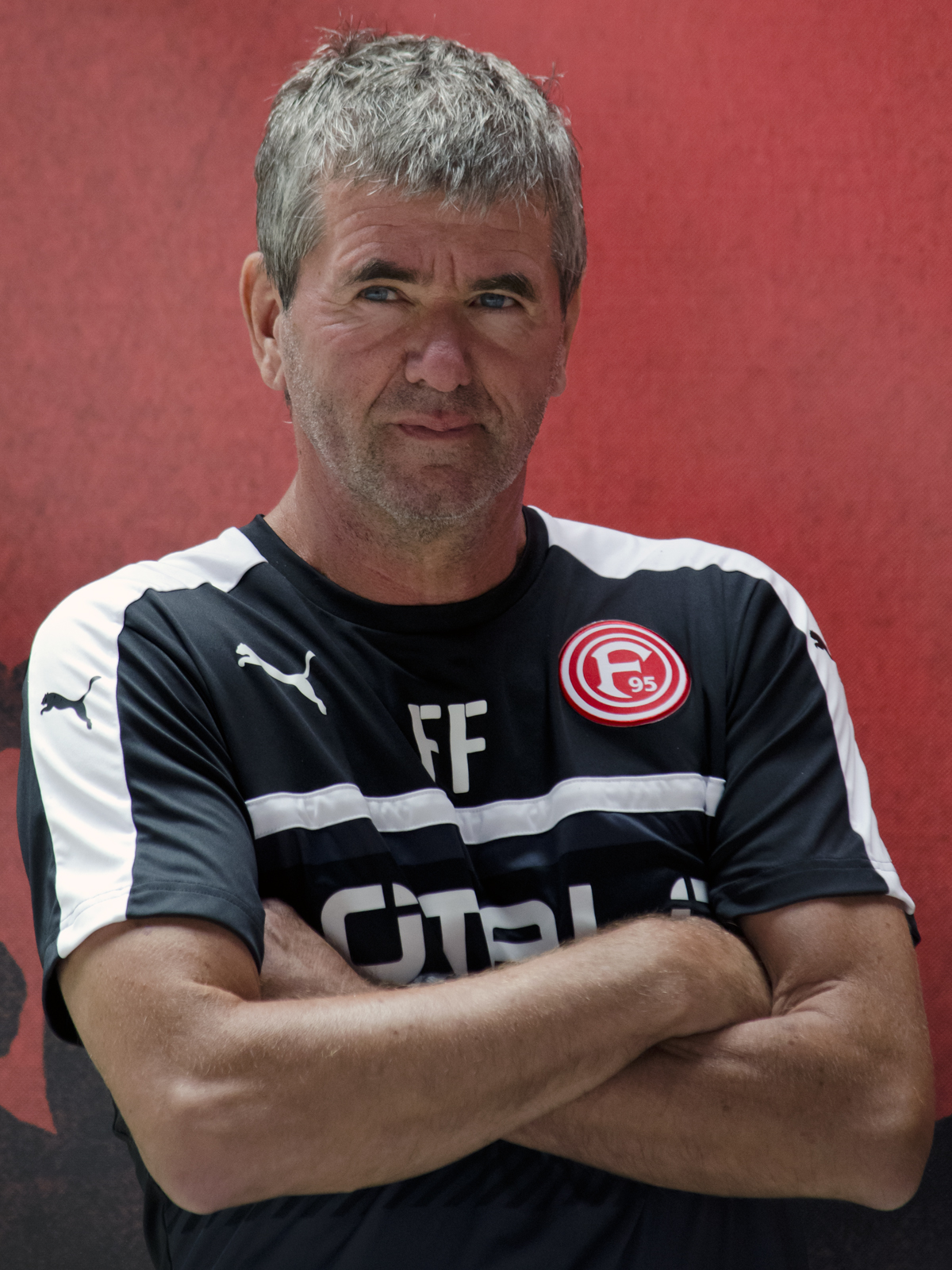
Under Karl-Heinz Feldkamp (1984–87), the club's only major trophy arrived. On 26 May 1985, in the first DFB-Pokal final staged at Berlin's Olympiastadion — the final returned to Berlin for the first time since 1942 and has been held there ever since — Bayer Uerdingen beat Bayern Munich 2–1 before 70,398: Dieter Hoeneß put the holders ahead on eight minutes, Horst Feilzer equalised a minute later, and Wolfgang Schäfer scored the winner on 66 minutes, captain Matthias Herget lifting the cup. A year later came the Wunder von der Grotenburg. In the Cup Winners' Cup quarter-final, Uerdingen lost the first leg 2–0 at Dynamo Dresden; in the return on 19 March 1986 they trailed 3–1 at half-time, 5–1 on aggregate, needing five second-half goals — Dresden's goalkeeper Bernd Jakubowski, his shoulder broken in a collision with Wolfgang Funkel, having been replaced at half-time by the inexperienced Jens Ramme. Six goals followed: Wolfgang Funkel twice from penalties, a Minge own goal, Schäfer twice and Dietmar Klinger — 7–3 on the night, 7–5 on aggregate. In a 2007 poll by the magazine 11 Freunde, more than 200 journalists, players and coaches voted it the greatest football match of all time. The semi-final was lost 4–2 on aggregate to Atlético Madrid, but the same season brought third place in the Bundesliga, the club's best-ever finish, and a UEFA Cup run to the round of 16 followed in 1986–87. The golden decade was carried by the Funkel brothers: Friedhelm, the club's record player and scorer in every scope — 479 appearances and 137 goals in all competitions, and Bundesliga records of 254 appearances and 59 goals — and defender Wolfgang, scorer of the Dresden hat-trick. Relegation in 1991 was answered by the 2. Bundesliga Nord title of 1991–92 under Friedhelm Funkel, now coach; down again in 1993, up again in 1994, safe in 15th place in 1995. Between 1983 and 1996 the club spent eleven of thirteen seasons in the Bundesliga.
5. Life after Bayer: third tier, licence withdrawal, insolvency (1995–2008)
In 1995 Bayer AG withdrew its sponsorship of the football department only; the department, as legal successor of FC Bayer 05 Uerdingen, took the name KFC Uerdingen 05, while the club's other departments continued as SC Bayer 05 Uerdingen. The first KFC season ended in relegation in last place in 1996, and the club has not played in the top flight since. The 1998–99 licence was granted only at the last attempt; after a squad exodus the club was relegated to the third tier in 1999. Five Regionalliga seasons followed. Insolvency applications were filed in 2003 and 2005, and on 25 May 2005 the DFB withdrew the club's licence for breaches of the licence conditions, relegating it to the fourth-tier Oberliga Nordrhein despite a ninth-place finish on the pitch. A benefit friendly against Bayern at the Grotenburg on 21 January 2006, doubling as the centenary highlight, drew 18,886 paying spectators. A third insolvency application, on 17 December 2007, was averted by fan campaigns, benefit friendlies and a €100,000 loan from Meerbusch businessman Agissilaos "Lakis" Kourkoudialos, who became chairman — but in 2008 the club missed the cut for the new Regionalliga and fell to the sixth tier.
6. Sixth tier, two rebuilds, the 3. Liga return and survival (2008–2026)

Kourkoudialos rebuilt from the sixth tier: Verbandsliga champions in 2010–11, a first promotion in seventeen years, a lost play-off in 2012, and Oberliga Niederrhein champions in 2012–13 with 96 points. Then came the second rebuild. Russian-born investor Mikhail Ponomarev became president at the end of June 2016 with the stated aim of returning the club to professional football, and delivered: Oberliga champions in 2016–17, Regionalliga West champions in 2017–18, and a promotion play-off against Waldhof Mannheim won 1–0 at home before the second leg in Mannheim on 27 May 2018 was abandoned in the 82nd minute with KFC leading 2–1 because of crowd trouble and later awarded 2–0 to KFC — promotion to the 3. Liga, professional football again after nineteen years. But the Grotenburg was closed: its standing areas had been shut by the city in 2013, renovation was approved in April 2018, and the club played in exile in Duisburg, Düsseldorf, Lotte and Velbert while some 450 volunteers of the Grotenburg Supporters renovated the ground with their own labour; KFC returned home in April 2022. Two mid-table 3. Liga seasons, with the Niederrheinpokal won in 2019, gave way to collapse: Ponomarev resigned on 13 January 2021, the professional company filed for insolvency in self-administration on 21 January 2021, and after the announced sale of his stake failed with the licence, the company was liquidated in June 2021. KFC finished 16th on the pitch with 41 points (after a three-point deduction), but were refused a licence for 2021–22, were placed last (20th) under §55a Abs. 3 of the DFB Spielordnung and were relegated; SV Meppen stayed up in their place. The member club played on, emerged debt-free in January 2022, climbed back to the Regionalliga in 2024 — and was withdrawn from that competition by an insolvency administrator on 22 April 2025, all its results annulled, though the club itself continued. The story closes in the fifth tier: third of eighteen in the Oberliga Niederrhein in 2025–26 with 63 points, the season completed under coach Julian Stöhr.
Honours
| Competition | Success | Notes |
|---|---|---|
| DFB-Pokal | Winners 1985 | 2–1 v Bayern Munich in Berlin — the club's only major trophy |
| European Cup Winners' Cup | Semi-finalists 1985–86 | The run included the 7–3 "Wunder von der Grotenburg" against Dynamo Dresden; the semi-final was lost to Atlético Madrid |
| DFB-Hallenpokal | Winners 1988 | The indoor cup |
| Intertoto Cup | Group winners 1988, 1990, 1991, 1992 | Group wins in the pre-UEFA Intertoto format — not UEFA trophies |
| 2. Bundesliga Nord | Champions 1991–92 | An immediate return to the Bundesliga |
| Regionalliga West | Champions 2017–18 | Followed by the promotion play-off win over Waldhof Mannheim |
| Niederrheinpokal | Winners 1982, 2001, 2019 | The 1982 win was by the club's amateur side |
| German youth championships | U19 and U17 champions 1987 | The first club to win both titles in the same season |
Timeline
- 1905 — 17 November: FC Uerdingen 05 founded by twelve citizens at the Hotel Kellner.
- 1927 — 18 September: the Grotenburg-Kampfbahn opens in Bockum, beside Krefeld Zoo.
- 1941 — 1 October: the wartime combined side KSG Uerdingen is formed with VfB Uerdingen 1910; a full merger follows in July 1945 and dissolves in 1948.
- 1953 — Merger with the Werkssportgruppe Bayer AG Uerdingen: the club becomes FC Bayer 05 Uerdingen.
- 1971 — Verbandsliga champions under Klaus Quinkert; promotion to the Regionalliga West.
- 1975 — First Bundesliga promotion via the play-offs against FK Pirmasens; relegated in 1976.
- 1977 — DFB-Pokal semi-finalists as a second-division side.
- 1983 — The promotion play-off against Schalke is won 4–2 on aggregate; eight straight top-flight seasons begin.
- 1985 — 26 May: the DFB-Pokal is won in Berlin, 2–1 v Bayern Munich before 70,398.
- 1986 — 19 March: the Wunder von der Grotenburg — 7–3 v Dynamo Dresden after trailing 1–3 at half-time; third place in the Bundesliga follows.
- 1987 — German U19 and U17 champions in the same season, a first for any club.
- 1992 — 2. Bundesliga Nord champions; relegated in 1993, promoted in 1994, safe in 1995.
- 1995 — Bayer withdraws from the football department, which continues as KFC Uerdingen 05; relegation follows in 1996.
- 2005 — 25 May: the DFB withdraws the club's licence; relegation to the fourth tier despite a ninth-place finish.
- 2007 — 17 December: a third insolvency application is averted by the fans and Lakis Kourkoudialos.
- 2008 — The club misses the Regionalliga cut and drops to the sixth tier.
- 2011 — Verbandsliga champions — the first promotion in seventeen years; Oberliga champions follow in 2013.
- 2016 — Mikhail Ponomarev becomes president at the end of June.
- 2018 — 27 May: the Mannheim play-off is abandoned at 2–1 to KFC and awarded 2–0 — promotion to the 3. Liga.
- 2021 — The professional company is liquidated after the licence fails; the member club plays on and emerges debt-free in January 2022.
- 2022 — April: return to the fan-renovated Grotenburg after almost four years in exile.
- 2025 — 22 April: the insolvency administrator withdraws the club from the Regionalliga; the club itself continues.
- 2026 — Third in the Oberliga Niederrhein with 63 points.
References
- KFC Uerdingen 05 — club history, honours and records cross-checked between the English and German reference records of the club, the DFB data centre and the Grotenburg-Stadion record; the name chain follows the German club record's official name history, and the stadium's 34,500 nominal capacity is printed only with the fence that 10,900 places are currently released for use.
- Player records are printed scope-locked: all competitions (club record table, dated 11 February 2021) — Friedhelm Funkel 479 appearances and 137 goals; Bundesliga only — Funkel 254 appearances and 59 goals, both club records. The 1985 final attendance is the settled 70,398.
Image source: Wikimedia Commons.


