 YAVE
Nottingham Forest
The history of Nottingham Forest: Garibaldi red, the 1959 FA Cup and Clough's two European Cups

Nottingham Forest began in 1865, when a group of shinty players meeting at the Clinton Arms in Nottingham voted to switch to association football. At the same meeting they resolved to buy twelve tasselled caps in "Garibaldi Red", named after the Italian revolutionary's Redshirts — and Forest have worn red ever since. They are one of the oldest clubs in world football, and on the EFL's own ruling the oldest club in the Football League.
Forest's history holds one of football's most improbable stories. After a first FA Cup in 1898 and decades of modest achievement, Brian Clough took a Second Division side to the league title in 1978 and then to back-to-back European Cups in 1979 and 1980 — leaving Forest, uniquely, with more European Cups (two) than league championships (one). The club has played at the City Ground, on the banks of the River Trent, since 1898; it now holds just over 31,000.
Contents
- Shinty Players, Garibaldi Red and the First FA Cup (1865–1939)
- Walker, the 1959 FA Cup and the Near Miss (1939–1975)
- The Clough Era: Two European Cups (1975–1993)
- Frank Clark's Revival and the Fall (1993–2005)
- The Third Tier and the Long Championship Years (2005–2021)
- The Cooper Revival and the Premier League Return (2021–present)
- Honours
- Timeline
- References
Shinty Players, Garibaldi Red and the First FA Cup (1865–1939)

Forest played their first official match against Notts County on 22 March 1866. They were pioneers of the early game: Sam Weller Widdowson is credited with inventing shin pads in 1874, and in 1886 Forest donated a set of kits to help the newly formed Arsenal — who still wear red. Rejected by the Football League at its formation in 1888, Forest won the Football Alliance in 1891–92 and then joined the League.
In 1898 Forest won their first major trophy, beating favourites Derby County 3–1 in the FA Cup final at Crystal Palace, Arthur Capes scoring twice. That same year they moved into the new City Ground, named because Nottingham had just been granted city status. The Edwardian years brought Grenville Morris, still the club's record scorer with 217 goals in all competitions between 1898 and 1913, but also decline: relegation in 1906 (followed by an immediate return as champions), again in 1911, and a near-collapse averted only by the First World War. Second Division champions in 1921–22, Forest survived two top-flight seasons before going down as the bottom club in 1925. Billy Walker was appointed manager in 1939, on the eve of war.
Walker, the 1959 FA Cup and the Near Miss (1939–1975)
Under Walker, Forest fell into the Third Division South in 1949 — then bounced back as champions in 1950–51, scoring a club-record 110 league goals, Wally Ardron contributing 36 of them. First Division football returned in 1957, and in 1959 came Forest's second FA Cup: Roy Dwight scored the opener against Luton Town at Wembley, broke his leg, and Forest — reduced to nine fit men — still won 2–1, with club-record appearance holder Bob McKinlay, who played 692 times in all competitions, in the side. Walker retired in 1960 after 21 years.
Johnny Carey's side of Joe Baker and Ian Storey-Moore then challenged Manchester United for the 1966–67 league title, finishing runners-up — Forest's best finish to that date — while a record crowd of 49,946 watched United at the City Ground in October 1967. But the peak was not built on. Carey left in 1968, and Forest were relegated in 1972 — the season Derby County, under Brian Clough, won the title. Short reigns by Dave Mackay and Allan Brown followed, and a Boxing Day home defeat by Notts County in 1974 prompted Brown's sacking.
The Clough Era: Two European Cups (1975–1993)
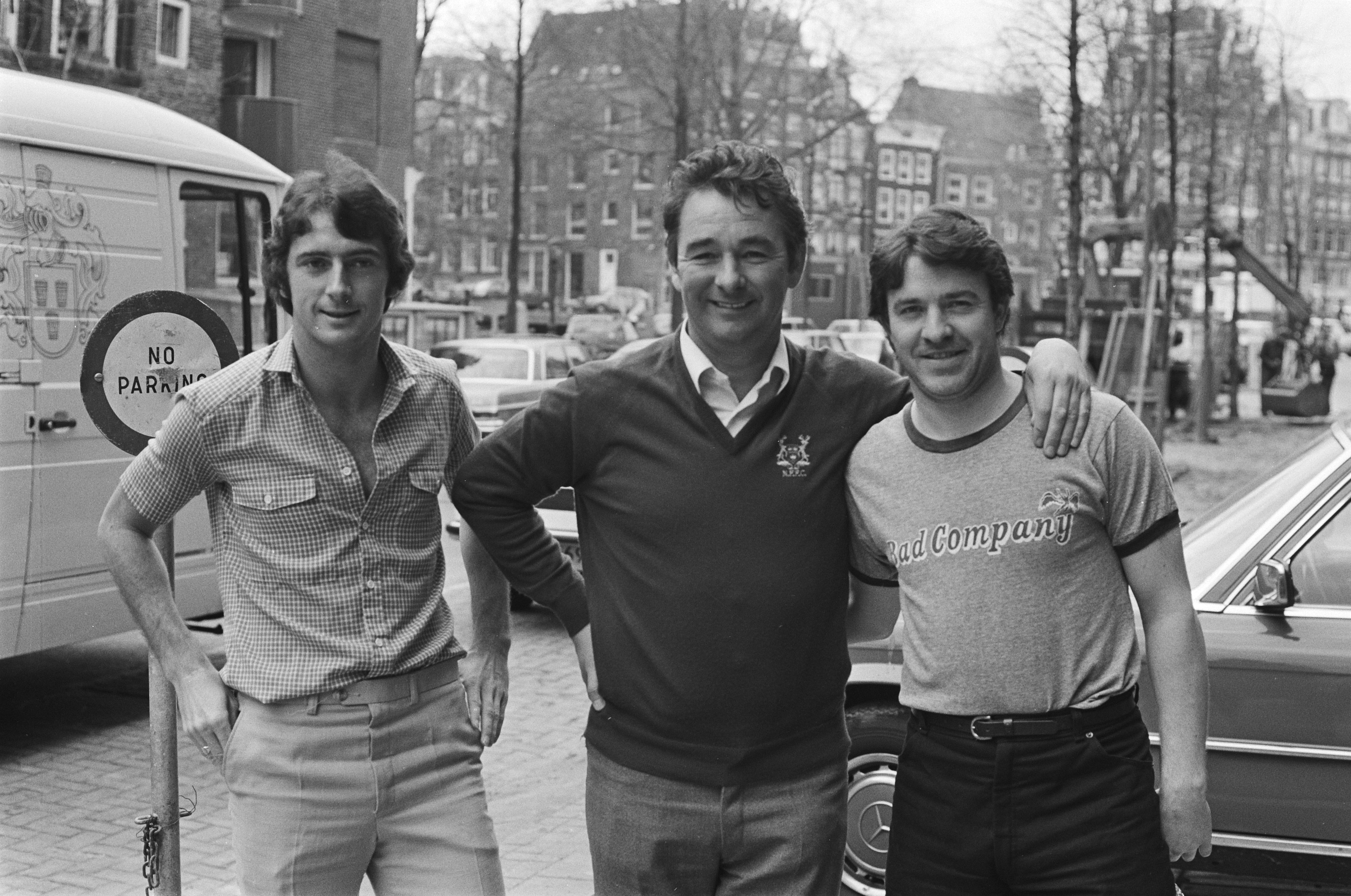
Brian Clough arrived on 6 January 1975, twelve weeks after his 44 days at Leeds United, with Forest mid-table in the Second Division. His assistant Peter Taylor rejoined him in July 1976 — talent-spotter to Clough's motivator. Promotion followed in 1977, and in 1977–78 Forest did something no club has matched since: they won the First Division title in their first season after promotion, seven points clear of Liverpool, conceding just 24 goals, with Peter Shilton in goal and Kenny Burns named Footballer of the Year. They also beat Liverpool in a replay to win the League Cup and began a 42-match unbeaten league run, ended by Liverpool in December 1978.
In 1979 Forest knocked holders Liverpool out of the European Cup in the first round, retained the League Cup against Southampton, signed Trevor Francis as English football's first £1 million player, and beat Malmö 1–0 in Munich — Francis heading the winner on his European debut. The European Super Cup followed, Barcelona beaten 2–1 on aggregate. In 1980 Forest retained the European Cup, John Robertson scoring the only goal against Hamburg in Madrid.

Taylor retired in 1982 and the great side was broken up, but Clough alone rebuilt: a UEFA Cup semi-final in 1984, third in the league in 1989, League Cups in 1989 (against Luton Town) and 1990 (against Oldham Athletic), the 1991 FA Cup final and the 1992 League Cup final — seven domestic cup finals in five seasons. The reign ended after 18 years with relegation in May 1993, in the Premier League's first season.
Frank Clark's Revival and the Fall (1993–2005)
Frank Clark, a defender in the 1979 European Cup-winning team, succeeded Clough and took Forest straight back up as Division One runners-up in 1993–94, then to third place in the Premier League in 1994–95 with Stan Collymore, and a UEFA Cup quarter-final in 1995–96. Clark left in December 1996; relegation followed in 1997, Dave Bassett's side won Division One in 1997–98 for an immediate return, and relegation again in 1999 began a 23-year exile from the top flight. David Platt spent heavily without success, and under Paul Hart Forest reached the 2003 play-offs — then slid through a quick succession of managers as debts mounted.
The Third Tier and the Long Championship Years (2005–2021)
In 2005 Forest were relegated to the third tier — the first former European Cup winners ever to fall into their domestic third division. Colin Calderwood's side lost a chaotic play-off semi-final to Yeovil Town in 2007, then won automatic promotion in 2007–08 with a league-record 24 clean sheets. Back in the Championship, Billy Davies twice took Forest to the play-offs without success. Owner Nigel Doughty died in February 2012; the Kuwaiti Al-Hasawi family bought the club and churned through managers. Evangelos Marinakis completed his takeover on 18 May 2017, the day Forest survived relegation on goal difference on the final day. Aitor Karanka, Martin O'Neill, Sabri Lamouchi and Chris Hughton all tried to end the exile; by September 2021 Forest were bottom of the Championship again.
The Cooper Revival and the Premier League Return (2021–present)

Steve Cooper was appointed on 21 September 2021 with Forest bottom of the Championship. He took them to fourth place, and on 29 May 2022 Forest beat Huddersfield Town 1–0 at Wembley — Premier League football for the first time since 1999. Forest signed a British-record 21 players that summer and survived in 2022–23, sealed by a 1–0 home win over Arsenal. Cooper was sacked in December 2023; his successor Nuno Espírito Santo kept Forest up in 2023–24 despite a four-point deduction for breaching profit and sustainability rules, then in 2024–25 took Forest to seventh place and European qualification for the first time in 30 years. A turbulent 2025–26 season of four managers — a Premier League first — followed.
Honours
| Trophy | Titles | Years |
|---|---|---|
| League title (First Division) | 1 | 1977–78 |
| FA Cup | 2 | 1897–98, 1958–59 |
| League Cup | 4 | 1977–78, 1978–79, 1988–89, 1989–90 |
| FA Charity Shield | 1 | 1978 |
| European Cup | 2 | 1978–79, 1979–80 |
| European Super Cup | 1 | 1979 |
| Second Division | 3 | 1906–07, 1921–22, 1997–98 |
| Third Division South | 1 | 1950–51 |
Forest's record scorer is Grenville Morris, with 217 goals in all competitions between 1898 and 1913, and their record appearance maker is Bob McKinlay, with 692 appearances in all competitions between 1951 and 1970. Forest remain the only club in Europe to have won the European Cup more times than their own domestic league championship.
Timeline
- 1865 — Shinty players meeting at the Clinton Arms, Nottingham, form Nottingham Forest Football Club and adopt Garibaldi red; the first official match follows against Notts County on 22 March 1866.
- 1892 — Forest win the Football Alliance and join the Football League, having been rejected at the League's formation in 1888.
- 1898 — First FA Cup: Forest beat Derby County 3–1 at Crystal Palace — and move into the new City Ground, their home ever since.
- 1951 — Third Division South champions with a club-record 110 league goals under Billy Walker, the start of the climb that restores First Division football in 1957.
- 1959 — Second FA Cup: Forest beat Luton Town 2–1 at Wembley despite Roy Dwight's broken leg, finishing with nine fit men.
- 1975 — Brian Clough becomes manager on 6 January, with Forest in the Second Division; Peter Taylor rejoins him as assistant in July 1976.
- 1977–78 — Promoted in 1977, Forest win the First Division title at the first attempt — still their only league championship — plus the League Cup, and begin a 42-match unbeaten league run.
- 1979 — European Cup winners in Munich (Malmö 1–0, Trevor Francis), a second straight League Cup, and the European Super Cup against Barcelona.
- 1980 — The European Cup is retained in Madrid (Hamburg 1–0, John Robertson) — two European Cups against one league title, a unique record in European football.
- 1989–90 — Clough's later side wins back-to-back League Cups (Luton Town, then Oldham Athletic); the 1991 FA Cup final and 1992 League Cup final are lost.
- 1993 — Clough's 18-year reign ends with relegation from the first Premier League season; Frank Clark takes Forest back up and to 3rd place in 1994–95, but relegations in 1997 and 1999 begin a 23-year top-flight exile.
- 2005 — Forest become the first European Cup winners to fall into their domestic third tier; promoted back in 2008.
- 2022 — Steve Cooper, appointed in September 2021 with Forest bottom of the Championship, wins the play-off final against Huddersfield Town (29 May) — Premier League football returns after 23 years.
- 2025 — Nuno Espírito Santo's Forest finish 7th in 2024–25, bringing European football back to the City Ground after 30 years.
References
- Wikipedia — "Nottingham Forest F.C." (history, honours and records).
- Wikipedia — "List of Nottingham Forest F.C. records and statistics".
- Premier League — official stadium guide (City Ground).
- Wikimedia Commons — file pages for the photographs used.
Image source: Wikimedia Commons.


