 YAVE
VfB Stuttgart
Rugby roots, a chest ring and the Young Wild Ones: five titles, two European final defeats and a cup after 18 years

VfB Stuttgart are Die Schwaben, the Swabians — Die jungen Wilden, the Young Wild Ones — of Stuttgart, capital of Baden-Württemberg. The club's full name is Verein für Bewegungsspiele Stuttgart 1893 e.V., and the 1893 is a merger compromise: FV Stuttgart was founded on 9 September 1893 at the Hotel Zum Becher as a rugby club, while FC Krone Cannstatt dated from 1897. The two merged on 2 April 1912 to form VfB Stuttgart, which celebrates 1893 as its birth year. The chest ring, the Brustring, arrived in 1925. Their home since 1933 is the MHPArena, holding 60,058 for league matches and 54,812 for international fixtures since the March 2024 rebuild.
Stuttgart have won five German championships — 1950 and 1952 before the Bundesliga, then 1984, 1992 and 2007 — and four DFB-Pokals, in 1954, 1958, 1997 and 2025. The 2025 Pokal was the club's first trophy in 18 years and its first cup in 28. They have lost two European finals, the 1989 UEFA Cup and the 1998 Cup Winners' Cup, and three relegations since 2016 sit inside a modern history of wild swings.
Contents
- Rugby roots and the road to the merger (1893–1912)
- Early VfB, war and the Gauliga years (1912–1945)
- The golden fifties (1945–1963)
- Bundesliga founders, the fall and the hundred-goal return (1963–1984)
- European finals, Buchwald's header and the Magic Triangle (1984–2001)
- Young wild ones, champions again, relegations and revival (2001–2026)
- Honours
- Timeline
- References
1. Rugby roots and the road to the merger (1893–1912)

Students at the Cannstatter Realschule founded FV Stuttgart in September 1893 to play rugby, still the dominant football code in the south-west; association football grew alongside it, and William Cavan, a teacher from Rugby in England, taught the rules to a generation of local schoolboys. Across the district, FC Krone Cannstatt was founded in 1897 and played association football only — and it was Krone that gave the merged club its defining colours: red and white, with the red chest ring that followed in 1925. The merger came on 2 April 1912, after negotiations that had run for years; FV's footballers gained Krone's purpose-built ground at Cannstatter Wasen, and the new club took the name Verein für Bewegungsspiele Stuttgart, retaining FV's 1893 as its foundation year.
2. Early VfB, war and the Gauliga years (1912–1945)

VfB won regional titles in the years around the First World War, and in 1933 moved to the new Adolf-Hitler-Kampfbahn in the Neckar valley — the ground, renamed repeatedly since, that the club still occupies. In the Gauliga Württemberg, VfB won the regional title in 1935, 1937, 1938 and 1943 and reached the German championship final in 1935, losing 4–6 to Schalke 04. War hollowed out the squad; two VfB players, Otto Bökle and Karl Burger, were killed in action. Play continued in the Gauliga until the 1944–45 season collapsed with the front approaching.
3. The golden fifties (1945–1963)
The Oberliga Süd years were Stuttgart's first golden age. VfB won the Southern German championship three times, in 1946, 1952 and 1954, and under coach Georg Wurzer converted the regional strength into two national titles: on 25 June 1950, in Berlin, Stuttgart beat Kickers Offenbach 2–1 in the German championship final; on 22 June 1952, in Ludwigshafen, they beat 1. FC Saarbrücken 3–2 to win the second. The DFB-Pokal followed twice — in 1954 against 1. FC Köln and in 1958 against Fortuna Düsseldorf. Robert Schlienz, the one-armed playmaker who lost his left arm in a car crash in 1948 and played on to captain the side, became the era's emblem. In 1963 VfB were founder members of the Bundesliga.
4. Bundesliga founders, the fall and the hundred-goal return (1963–1984)
The Bundesliga began with mid-table finishes and the 1964 signing of Gilbert Gress from Strasbourg. The fall came in 1975: relegation after finishing 16th, and two seasons in the 2. Bundesliga Süd. The return in 1977 was spectacular — Jürgen Sundermann's young side, with Hansi Müller, Karlheinz Förster and Dieter Hoeneß, scored 100 goals in the promotion season. By 1979 they were runners-up, behind Hamburg on goal difference, and European semi-finalists. The championship finally arrived in 1984: Helmut Benthaus's team took the title on goal difference from Hamburg and Werder Bremen, three clubs level at the top on 48 points — Stuttgart's first championship in 32 years.
5. European finals, Buchwald's header and the Magic Triangle (1984–2001)

The great European near-miss came in 1989: Stuttgart reached the UEFA Cup final with Jürgen Klinsmann — who missed the first leg — in the side, but Maradona's Napoli won it 5–4 on aggregate. Three years later came one of the Bundesliga's great final days: on 16 May 1992, under Christoph Daum, Guido Buchwald's 86th-minute header at Bayer Leverkusen — Stuttgart playing with ten men after Matthias Sammer's 79th-minute dismissal — won the championship, with three clubs level on 50 points. The 1993–94 season ended the club's first Champions League group campaign; in 1997 Joachim Löw's side won the DFB-Pokal, 2–0 against Energie Cottbus, with the "Magic Triangle" of Krassimir Balakov, Giovane Élber and Fredi Bobic. A year later Löw's team lost the Cup Winners' Cup final 1–0 to Chelsea in Stockholm, Gianfranco Zola scoring the winner. By 2001 the club was fighting relegation again.
6. Young wild ones, champions again, relegations and revival (2001–2026)
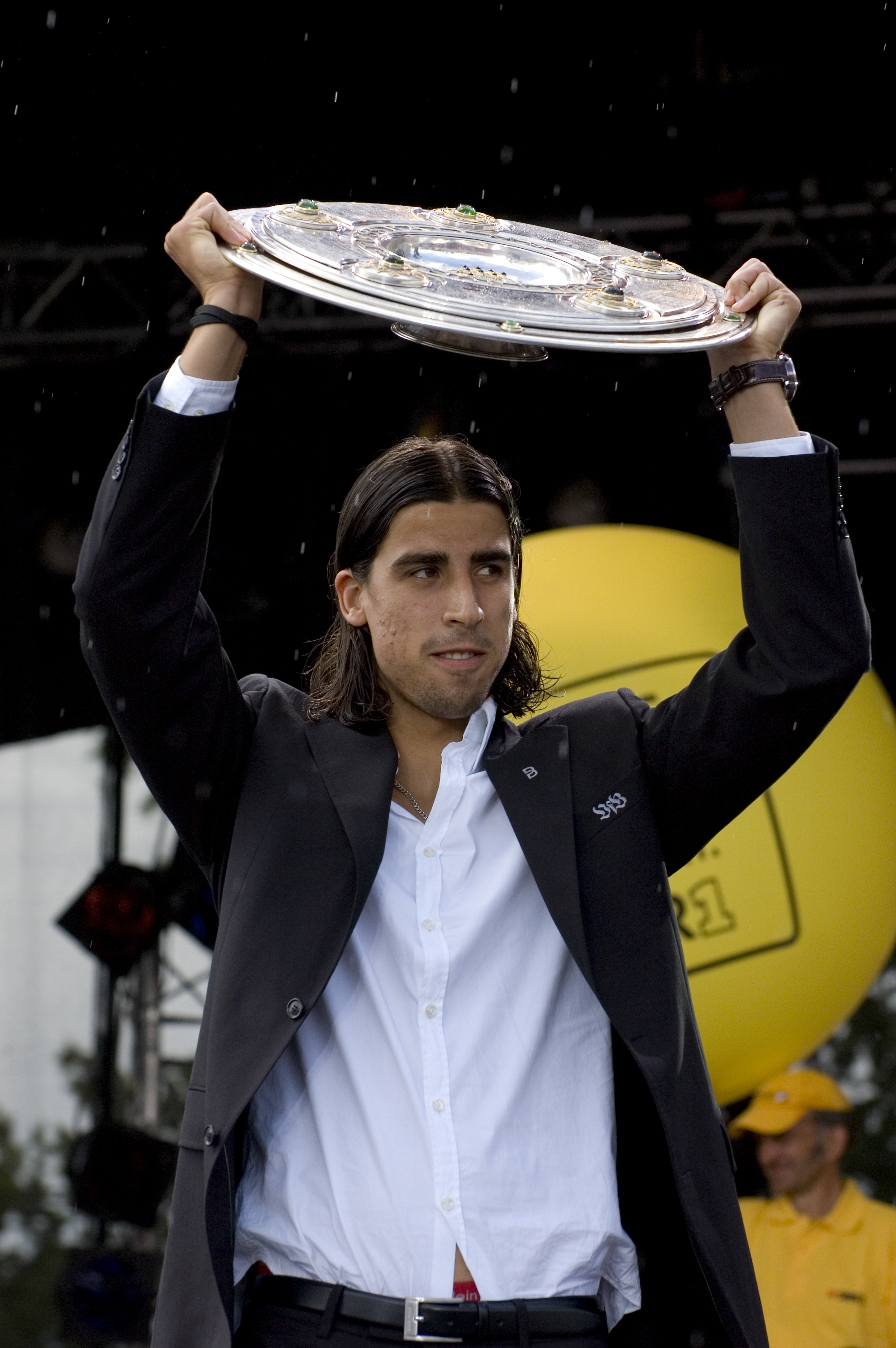
Felix Magath's 2001–03 side of cheap signings and academy products — Kevin Kurányi, Timo Hildebrand, Aleksandr Hleb — were the original "jungen Wilden", finishing runners-up in 2003. Armin Veh's team of 2006–07, the "jungen Wilden II", went further: on 19 May 2007 Stuttgart won their fifth championship, Mario Gómez scoring 16 goals and academy products Sami Khedira and Serdar Tasci at the side's core. Then the wheel turned: relegation in 2016 after 39 unbroken top-flight years, instant return as 2. Bundesliga champions, relegation again in 2019 — losing the play-off to Union Berlin on away goals after draws of 2–2 and 0–0 — another instant return, and survival in the 2023 play-off against Hamburg, 6–1 on aggregate. Sebastian Hoeneß, appointed in April 2023, transformed the club: in 2023–24 Stuttgart finished second with 73 points, a club record, Serhou Guirassy scoring 28 Bundesliga goals, a club Bundesliga-season record. In 2024–25 came the fourth DFB-Pokal, 4–2 against Arminia Bielefeld — the first trophy since 2007 and the first cup since 1997 — alongside a Champions League return. The 2025–26 season ended with fourth place in the Bundesliga, a Europa League round-of-16 run and the DFB-Pokal final, lost 0–3 to Bayern Munich, Harry Kane's hat-trick deciding it. The club's records are scope-locked: Hermann Ohlicher made 460 appearances in all competitions, scoring 157 goals; Karl Allgöwer holds the Bundesliga records, 338 appearances and 129 goals. The club reported 135,000 members in July 2026.
Honours
| Competition | Success | Notes |
|---|---|---|
| German championship | Champions 1949–50, 1951–52, 1983–84, 1991–92, 2006–07 | Two pre-Bundesliga titles and three Bundesliga titles; runners-up in 1935, 1953, 1979, 2003 and 2024 |
| DFB-Pokal | Winners 1953–54, 1957–58, 1996–97, 2024–25 | The 2025 win (4–2 v Arminia Bielefeld) was the first trophy in 18 years; runners-up in 1986, 2007, 2013 and 2026 |
| UEFA Cup | Finalists 1988–89 | Lost 4–5 on aggregate to Napoli |
| European Cup Winners' Cup | Finalists 1997–98 | Lost 0–1 to Chelsea in Stockholm |
| DFL-Supercup | Winners 1992 | Beat Hannover 96 3–1 |
| 2. Bundesliga | Champions 2016–17 | Promoted straight back after the 2016 relegation; also promoted in 1977 and 2020 |
| Oberliga Süd | Champions 1945–46, 1951–52, 1953–54 | The regional titles of the golden fifties |
Timeline
- 1893 — 9 September: FV Stuttgart founded as a rugby club at the Hotel Zum Becher.
- 1897 — FC Krone Cannstatt founded — the source of the red-and-white colours.
- 1912 — 2 April: FV Stuttgart and FC Krone Cannstatt merge to form VfB Stuttgart 1893.
- 1925 — The red chest ring (Brustring) is introduced.
- 1933 — 23 July: the club moves to the new Adolf-Hitler-Kampfbahn, the site of today's MHPArena.
- 1935 — German championship final lost 4–6 to Schalke 04.
- 1950 — 25 June: first German championship — 2–1 v Kickers Offenbach in Berlin.
- 1952 — 22 June: second championship — 3–2 v 1. FC Saarbrücken in Ludwigshafen.
- 1954 / 1958 — The first two DFB-Pokals, v 1. FC Köln and Fortuna Düsseldorf.
- 1963 — VfB are founder members of the Bundesliga.
- 1975 — Relegated after 16th place; two seasons in the 2. Bundesliga Süd.
- 1977 — Promotion back, with 100 goals scored in the season.
- 1984 — Third championship: the title on goal difference with three clubs level on 48 points — the first in 32 years.
- 1989 — UEFA Cup final lost to Napoli, 4–5 on aggregate.
- 1992 — 16 May: fourth championship — Buchwald's 86th-minute header at Leverkusen with ten men, three clubs level on 50 points.
- 1997 — Third DFB-Pokal: 2–0 v Energie Cottbus.
- 1998 — Cup Winners' Cup final lost 0–1 to Chelsea in Stockholm.
- 2007 — 19 May: fifth championship under Armin Veh — the "jungen Wilden II".
- 2016 — Relegated after 39 unbroken top-flight years; 2. Bundesliga champions and straight back in 2017.
- 2019 — Relegated again, losing the play-off to Union Berlin on away goals; straight back in 2020.
- 2024 — Second in the Bundesliga with a club-record 73 points; Guirassy's 28 goals a club Bundesliga-season record; the MHPArena rebuild completed in March (60,058 league capacity).
- 2025 — 24 May: fourth DFB-Pokal — 4–2 v Arminia Bielefeld, the first trophy in 18 years.
- 2026 — Fourth in the Bundesliga, a Europa League round of 16, and the DFB-Pokal final lost 0–3 to Bayern Munich.
References
- VfB Stuttgart — club history, honours and records, cross-checked between the English and German reference records of the club and the club's official site vfb.de (foundation 9 September 1893; merger 2 April 1912; the MHPArena record — opened 23 July 1933, capacity 60,058 for league matches and 54,812 for international matches since the March 2024 rebuild), bundesliga.com, UEFA.com and DFB reporting on the 2025 DFB-Pokal final.
- The records, scope-locked: all competitions — Hermann Ohlicher 460 appearances and 157 goals; Bundesliga only — Karl Allgöwer 338 appearances and 129 goals. No all-competitions top scorer is printed, because the German and English records conflict irreconcilably (a 202-goal figure against a 157-goal figure) and neither is verified.
Image source: Wikimedia Commons.


