 YAVE
SC Freiburg
The Breisgau way: no trophies, two legendary coaches, and a European final in Istanbul

SC Freiburg are the Breisgau club from Freiburg im Breisgau in Baden-Württemberg, at the edge of the Black Forest — a small, member-owned club famous for patience, youth development and doing things their own way. Their crest carries the griffin head adopted in 1912. Since October 2021 they have played at the Europa-Park Stadion, capacity 34,700 (22,300 seats and 12,400 standing), after 67 years at the little Dreisamstadion across the city.
Freiburg have never won a major trophy. Their honours are four 2. Bundesliga championships (1992–93, 2002–03, 2008–09, 2015–16), a best Bundesliga finish of third in 1994–95, a lost DFB-Pokal final in 2022 — and, at the very end of this story, a lost UEFA Europa League final in 2026. What they have instead is a reputation: the club that keeps its coaches for decades and keeps coming back.
Contents
- Two clubs, one griffin (1904–1945)
- Rebirth, the Dreisamstadion and the long amateur wait (1945–1978)
- Fifteen years in the second division (1978–1991)
- The Finke era — Brazilians in the Breisgau (1991–2007)
- Dutt, disaster averted, and the Streich era (2007–2024)
- The Schuster succession and a European final (2024–2026)
- Honours
- Timeline
- References
1. Two clubs, one griffin (1904–1945)
Freiburg's official founding date is 30 May 1904 — but that was the founding day of FC Schwalbe, one of two root clubs. The other, Freiburger FV 04, had been founded on 3 March 1904. Through name changes — Mars, Union, SV 04 — the two lines converged, and on 3 March 1912 SV Freiburg 04 and Union Freiburg merged to form Sport-Club Freiburg, adopting the griffin head that still marks the crest. The modern club was thus formed by a merger in 1912, not in 1904; the 1904 date is the root club's, kept as the official birthday. The early decades were modest: a wartime combination with Freiburger FC in 1918, life as the football department of FT 1844 from 1919 to 1928 and again from 1938, the Winterer-Stadion years from 1928 until the ground was lost to the Luftwaffe in 1936, and a single Gauliga Baden season in 1933–34 that ended in relegation. Throughout, Freiburg stood in the shadow of Freiburger FC — a separate club, and the German champions of 1907.
2. Rebirth, the Dreisamstadion and the long amateur wait (1945–1978)
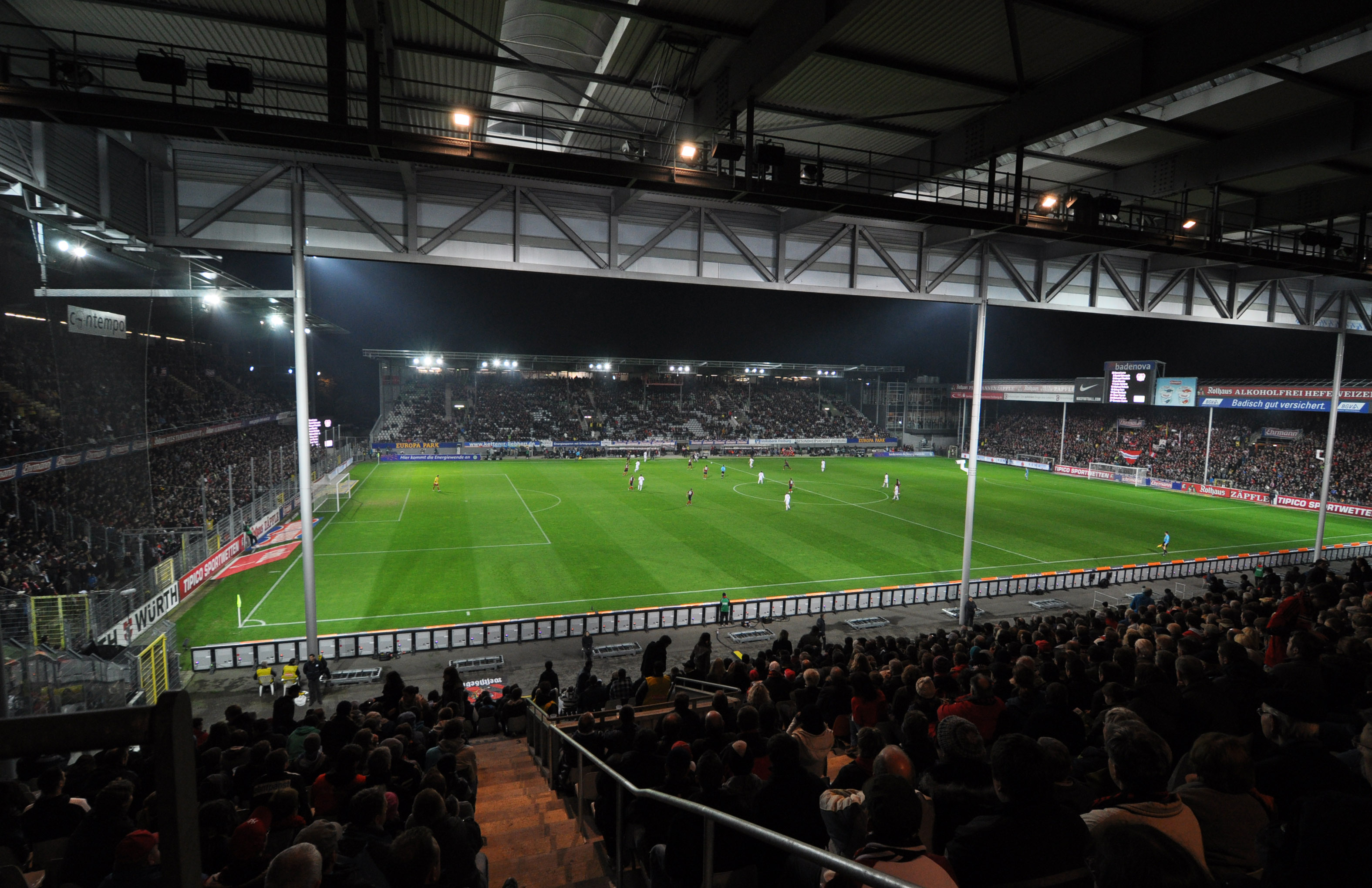
Dissolved after the war, the club played briefly as VfL Freiburg before regaining full independence in 1952. On 1 September 1954 the Dreisamstadion opened — a tight ground in the east of the city that would grow, stand by stand, into one of German football's most loved homes; by its final years it held 24,000 for league matches (18,000 in its international configuration) and wore solar panels on its roof. On the pitch, three decades in the Amateurliga Südbaden brought titles in 1965 and 1968, both wasted in failed promotion rounds. The turning figure was Achim Stocker, third chairman from 1970 and president from 1972, who professionalised the club step by step. In 1978, under coach Manfred Brief, Freiburg won the title again and this time survived the promotion round — entering the 2. Bundesliga and overtaking Freiburger FC as the city's leading club.
3. Fifteen years in the second division (1978–1991)
After a stopgap season at Freiburger FC's Möslestadion in 1978–79, Freiburg settled into the 2. Bundesliga Süd and then into the single-tier second division from 1981. They were respectable, stable and never close to promotion — a well-run club waiting for its moment. The era's defining player was a forward named Joachim Löw, who across three spells scored 81 league goals in 252 league appearances — all of them in the second division — and was made an honorary captain. His club record stood until 2020. The Dreisamstadion grew slowly around the team, and Stocker's patient building laid the foundations for what came next.
4. The Finke era — Brazilians in the Breisgau (1991–2007)

On 1 July 1991 Stocker appointed Volker Finke, and German football changed a little. After a near miss in 1991–92, Freiburg won the 2. Bundesliga in 1993 and reached the Bundesliga for the first time. Survival came on the final stretch in 1994; then, in 1994–95, the miracle: third place with 46 points under the two-points-for-a-win system, just three points behind champions Borussia Dortmund, a 5–1 win over Bayern Munich, and a joyful passing side the press christened the "Breisgau-Brasilianer" — the Breisgau Brazilians. A first UEFA Cup followed. The pattern of the Finke years was set: relegation in 1997 and an instant return as runners-up in 1998; sixth place and Europe again in 2001; down in 2002, champions in 2003, bottom in 2005 with just 18 points, the club's worst top-flight season. Along the way the solar stadium and the club's football school were built. Finke resigned on 20 May 2007 after sixteen years — at the time the longest tenure in German professional football (a mark since passed by Frank Schmidt in 2023).
5. Dutt, disaster averted, and the Streich era (2007–2024)

Robin Dutt rebuilt the side and won the 2. Bundesliga title and promotion in 2009; Papiss Cissé's goals lit up 2010–11. Dutt left, Marcus Sorg lasted six months, and on 29 December 2011 the club turned to its assistant and youth coach Christian Streich. The Streich era delivered fifth place and a first DFB-Pokal semi-final in 2013 — a Champions League place lost only on the final day — then relegation in 2015 by a single point. The club kept faith, and Freiburg came straight back as champions in 2016 with 72 points, Nils Petersen's goals central; Petersen would end with 105 goals in 276 appearances in all competitions for Freiburg, a club record, and a career record 34 Bundesliga goals as a substitute. European nights became routine. In October 2021 the club moved to the Europa-Park Stadion: a 3–0 friendly win over FC St. Pauli on 7 October, then a 1–1 Bundesliga draw with RB Leipzig on 16 October in the first league match there. On 21 May 2022 came the club's first DFB-Pokal final: Maximilian Eggestein put Freiburg ahead in the 19th minute, Leipzig had Marcel Halstenberg sent off, Christopher Nkunku equalised, and Leipzig won the shoot-out 4–2 — their first major trophy. Fifth place followed in 2023, with a Europa League round-of-16 tie against Juventus. Captain Christian Günter had become the club's Bundesliga appearance record holder in 2021. Streich announced his farewell on 18 March 2024 and coached the side to the end of 2023–24, closing twelve and a half years in charge and 29 years at the club. The club's membership reached 80,000 in January 2026.
6. The Schuster succession and a European final (2024–2026)

Streich's successor came from inside: Julian Schuster, the former captain with 242 playing appearances for the club, was announced on 22 March 2024 and took charge that summer. His first season ended fifth in 2024–25, another final-day Champions League near miss in a 1–3 defeat by Eintracht Frankfurt. Günter's records kept growing: on 9 November 2025 he made his 441st competitive appearance, passing Rico Zeyer's 440 to become the club's all-time appearance record holder; he closed 2025–26 with 370 Bundesliga appearances and 401 league appearances, while Vincenzo Grifo's 72 goals made him the club's record Bundesliga scorer. The 2025–26 season brought a DFB-Pokal semi-final, lost at VfB Stuttgart after extra time — Eggestein scoring Freiburg's goal — before Stuttgart themselves lost the final 0–3 to Bayern. And it brought the run of the club's life in the Europa League: KRC Genk beaten 5–2 on aggregate, Celta Vigo 6–1, Braga 4–3, and a first European final. On 20 May 2026, at the Beşiktaş Stadium in Istanbul before 37,324 spectators, Aston Villa won 3–0 — Youri Tielemans in the 41st minute, Emiliano Buendía in first-half stoppage time, Morgan Rogers in the 58th. Four days earlier Freiburg had closed the league season with a 4–1 home win over RB Leipzig, finishing 7th with 47 points (13 wins, 8 draws, 13 defeats; 51:57 goals), Igor Matanović their top league scorer with eleven. A final lost, a club transformed: Freiburg stand 18th in the all-time Bundesliga table.
Honours
| Competition | Success | Notes |
|---|---|---|
| Major trophies | None | Freiburg have never won a major trophy; the honours below are titles and best finishes |
| Bundesliga | Best finish: 3rd (1994–95) | 46 points under the two-points system, three behind champions Dortmund; the "Breisgau-Brasilianer" season |
| DFB-Pokal | Runners-up 2022 | First final: 1–1 with RB Leipzig, lost 2–4 on penalties; semi-finalists 2013 and 2026 |
| UEFA Europa League | Runners-up 2025–26 | First European final: lost 0–3 to Aston Villa in Istanbul, 20 May 2026 |
| 2. Bundesliga | Champions 1992–93, 2002–03, 2008–09, 2015–16 | Five promotions in all; 1998 the only one as runners-up |
Timeline
- 1904 — 3 March: Freiburger FV 04 founded, the older of the club's two root clubs; 30 May: FC Schwalbe founded — the date SC Freiburg officially celebrates as its founding.
- 1912 — 3 March: SV Freiburg 04 and Union Freiburg merge to form Sport-Club Freiburg; the griffin head is adopted.
- 1918 — Wartime combination with Freiburger FC as KSG Freiburg.
- 1928 — The club opens the Winterer-Stadion, its first ground of its own (given up in 1936 for a Luftwaffe airfield).
- 1933–34 — One Gauliga Baden season ends in relegation, bottom of the table.
- 1952 — The footballers leave FT 1844 for good and re-found the independent SC Freiburg after the VfL interlude.
- 1954 — 1 September: the Dreisamstadion opens.
- 1965 / 1968 — Amateurliga Südbaden titles, both followed by failed promotion rounds.
- 1972 — Achim Stocker becomes president; he will run the club until his death in 2009.
- 1978 — Third Amateurliga title and a successful promotion round: Freiburg reach the 2. Bundesliga for the first time.
- 1978–1989 — Joachim Löw's three spells as a player: 81 league goals in 252 league games, a club record that stands until 2020.
- 1991 — 1 July: Volker Finke appointed head coach.
- 1992–93 — 2. Bundesliga champions — promoted to the Bundesliga for the first time.
- 1994–95 — Third in the Bundesliga, three points behind champions Dortmund; the Breisgau-Brasilianer nickname is born; first UEFA Cup qualification.
- 1995–96 — European debut: UEFA Cup first round, lost to Slavia Prague.
- 1997 / 1998 — First Bundesliga relegation, then immediate promotion as 2. Bundesliga runners-up.
- 2000–01 — Sixth place and a second UEFA Cup campaign (third round v Feyenoord, 2001–02).
- 2002 / 2003 — Relegated, then 2. Bundesliga champions again.
- 2004–05 — Bottom of the Bundesliga with 18 points — the club's worst top-flight season.
- 2007 — 20 May: Finke resigns after 16 years in charge.
- 2009 — 10 May: promotion sealed with a 5–2 win at TuS Koblenz; Freiburg end as 2. Bundesliga champions under Robin Dutt.
- 2011 — 29 December: Marcus Sorg dismissed; assistant Christian Streich becomes head coach.
- 2012–13 — Fifth place, and a first DFB-Pokal semi-final; a Champions League place is lost on the final day against Schalke.
- 2014–15 / 2015–16 — Relegated by a single point, then 2. Bundesliga champions (72 points) at the first attempt, ahead of RB Leipzig.
- 2015 — 31 January: Nils Petersen scores a hat-trick on his Freiburg debut, as a half-time substitute, in a 4–1 win over Eintracht Frankfurt.
- 2019 — 19 January: Petersen becomes Freiburg's record Bundesliga scorer with his 38th Bundesliga goal.
- 2020 — January: Petersen's 84th Freiburg goal (2–1 v Mainz) breaks Joachim Löw's all-competitions club record.
- 2021 — 21 August: Christian Günter becomes Freiburg's Bundesliga appearance record holder (237th appearance); 26 September: the last first-team match at the Dreisamstadion (3–0 v FC Augsburg); 7 October: the Europa-Park Stadion opens with a 3–0 friendly win over FC St. Pauli; 16 October: first Bundesliga match at the new stadium, 1–1 v RB Leipzig.
- 2022 — 21 May: the club's first DFB-Pokal final — 1–1 v RB Leipzig, lost 2–4 on penalties.
- 2023 — 19 May: Petersen's farewell home goal: his 105th for Freiburg and a record 34th Bundesliga goal as a substitute.
- 2024 — 18 March: Streich announces he will step down at the end of the season; 22 March: Julian Schuster is announced as his successor and takes charge in the summer.
- 2025 — 9 November: Günter makes his 441st competitive appearance, becoming the club's all-time appearance record holder.
- 2026 — 16 May: the league season ends with a 4–1 home win over RB Leipzig; Freiburg finish 7th. 20 May: UEFA Europa League final, Istanbul — Freiburg 0–3 Aston Villa, the article's closing point.
References
- SC Freiburg — club history, honours and records, cross-checked between the English and German reference records of the club, the club's official site, bundesliga.com, the DFB data centre and the SC Freiburg and UEFA reports of the 2025–26 Europa League final (Günter's appearance records and Grifo's 72 Bundesliga goals are stated as at the end of 2025–26).
- The account of the 2022 DFB-Pokal final (Eggestein 19', Halstenberg sent off, Nkunku's equaliser, the 2–4 shoot-out) follows the settlement in the published Yavex history of RB Leipzig, whose first major trophy it was.
Image source: Wikimedia Commons.


